
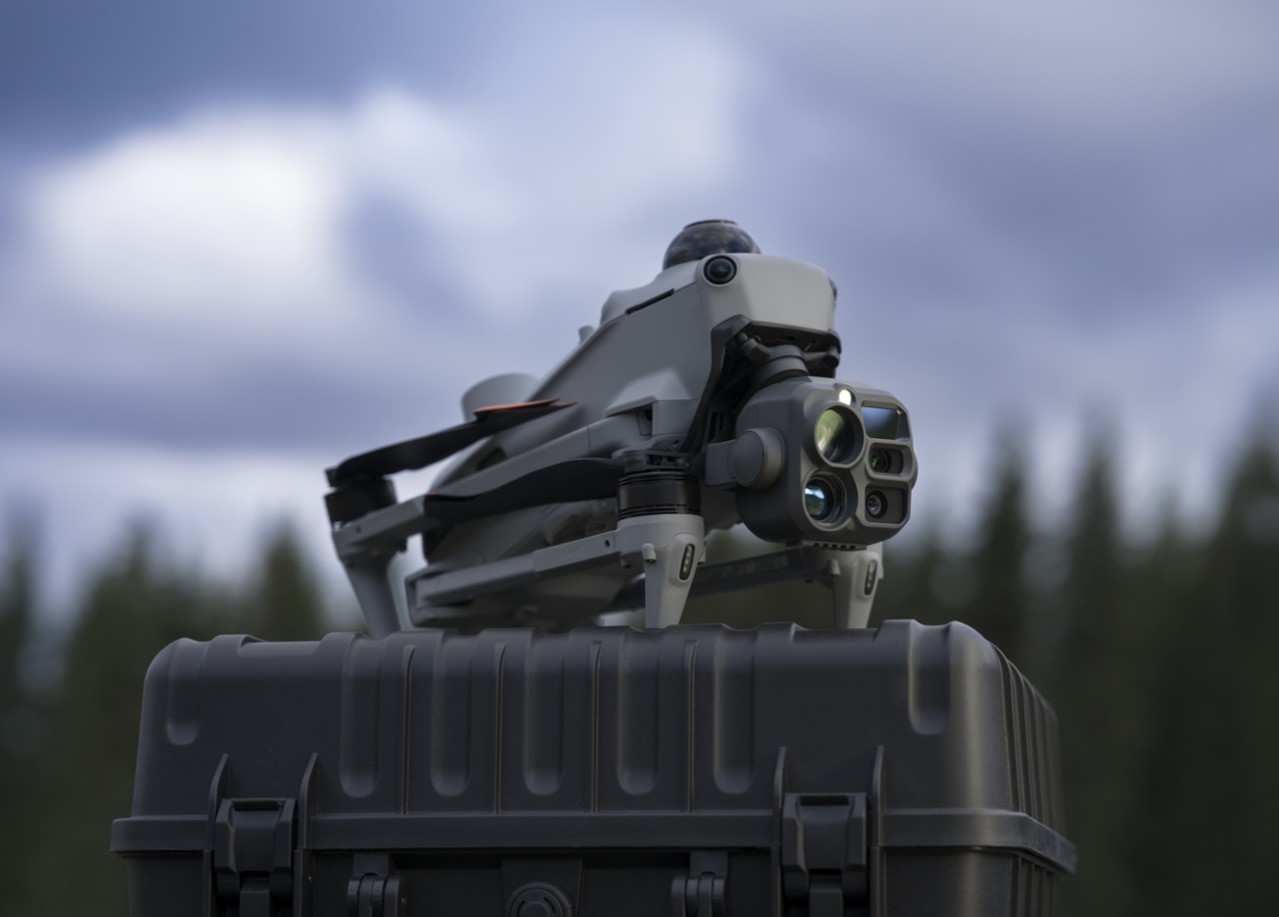
The DJI Matrice 5T brings together high-resolution thermal imaging, powerful zoom capabilities, advanced obstacle sensing and mapping features in a portable enterprise drone.
Designed for organisations that need one aircraft for multiple tasks, the Matrice 5T is suited to applications such as search and rescue, emergency response, infrastructure inspection, public safety and aerial mapping.
Compared with the DJI Matrice 4T, the Matrice 5T introduces a higher-resolution thermal camera, a longer telephoto lens, built-in LiDAR and millimetre-wave radar, an IP55 rating and extended flight time. These upgrades give operators more tools to collect information and work confidently in challenging environments.
DJI Matrice 5T at a Glance
- IP55-rated aircraft for improved dust and water resistance.
- 1280 × 1024 native thermal resolution — four times the thermal pixel count of the Matrice 4T.
- Up to 176× hybrid zoom with an 11× telephoto camera.
- Built-in LiDAR, mmWave radar and omnidirectional vision sensing.
- Up to 59 minutes of maximum flight time.
- Up to 3 km laser ranging for measuring distance and marking targets.
- More than 20 onboard AI detection categories across visible and thermal workflows.
- Local 2.5D mapping and support for more accurate mapping workflows.
- Dual built-in 4G modules on the aircraft.
- Up to 400 g accessory payload capacity.
Portable Design with IP55 Protection
Weighing approximately 2.239 kg, the Matrice 5T offers a substantial increase in capability while retaining a folding design that can be transported and deployed by a small team.
The aircraft features an IP55 rating, providing protection against dust and water ingress. This is a significant development for organisations that need a portable drone capable of operating in more demanding conditions, where rain or dust might otherwise interrupt a mission.
The Matrice 5T also has a stated operating temperature range of −20°C to +50°C, compared with −10°C to +40°C for the Matrice 4T. As with any aircraft, operators should assess the actual weather conditions and follow DJI’s operating guidance before each flight.
With a maximum accessory payload of 400 g, the aircraft can be equipped with compatible accessories such as the DJI AL2 Spotlight and DJI AS2 Speaker. These accessories can support tasks such as illuminating an inspection area, communicating with people on the ground or guiding emergency response teams.
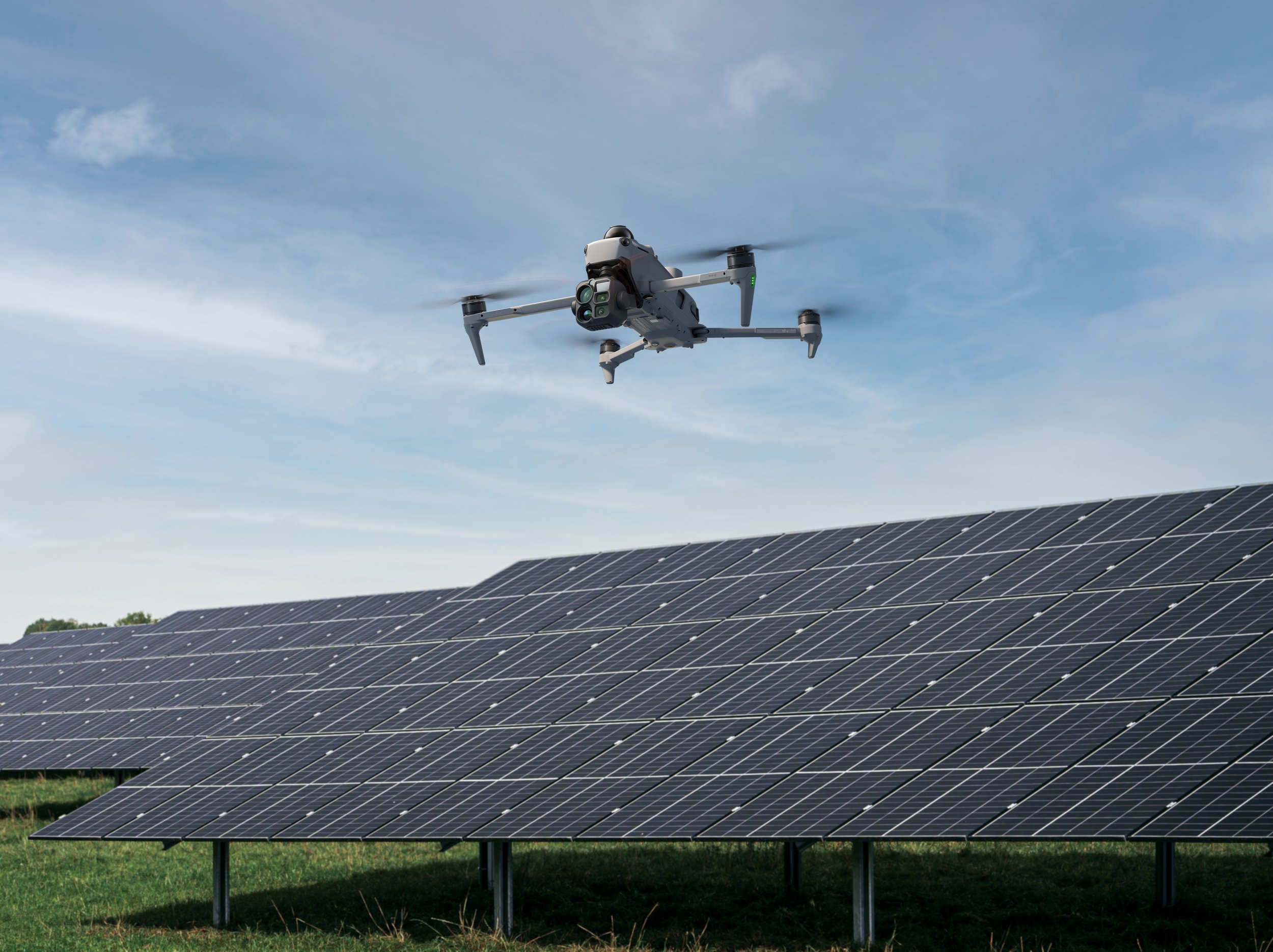
High-Resolution Thermal Imaging
One of the most significant upgrades on the Matrice 5T is its 1280 × 1024 native thermal camera. By comparison, the Matrice 4T has a native thermal resolution of 640 × 512.
That means the Matrice 5T has twice as many thermal pixels across and down, resulting in four times the total native thermal pixel count. The additional detail can help operators distinguish a person or animal from the surrounding environment, identify a hotspot on infrastructure or better understand the shape and position of a heat source.
The thermal camera also supports 2560 × 2048 ultra-high-resolution thermal output, using image enhancement to provide a larger output. Its native sensor resolution remains 1280 × 1024.
Thermal Fusion and Edge Enhancement
The Matrice 5T can combine thermal and visible imagery through its Fusion and Edge Enhancement features. These modes add visual context to thermal information, making it easier to identify the structure or component associated with a heat signature.
For example, during an electrical inspection, an operator can view a hotspot while also seeing the outlines of the equipment around it. This can help the team understand which component needs closer investigation.
Professional Temperature Calibration
The Matrice 5T introduces a temperature-calibration capability using blackbody references. This provides a professional calibration workflow for organisations that need to maintain confidence in their thermal temperature measurements over time.
DJI advises that calibration should only be performed under professional guidance, as incorrect calibration can reduce temperature-measurement accuracy.
A Versatile Camera System
Alongside its thermal camera, the Matrice 5T features wide, medium telephoto and telephoto cameras. Together, these cameras help operators move from a broad overview of a scene to a closer inspection of a subject or asset.
Wide Camera
The wide camera features a 1/0.98-inch CMOS sensor and supports up to 50 MP imagery. It is useful for capturing an overview of an incident, photographing a large structure, documenting a site and collecting mapping data.
The larger sensor also supports improved low-light performance. DJI states that the wide camera can capture full-colour imagery in light levels as low as 0.01 lux, under its specified conditions.
Medium Telephoto Camera
The 70 mm equivalent medium telephoto camera provides a useful view between the wide and long telephoto cameras. It allows operators to move closer to a subject while retaining more surrounding context than a highly zoomed image.
This can be useful when inspecting a bridge, pole, building facade or other asset where the operator needs detail without losing sight of the wider structure.
11× Telephoto Camera with up to 176× Hybrid Zoom
The Matrice 5T’s telephoto camera has a 252 mm equivalent focal length and supports up to 176× hybrid zoom. The Matrice 4T, by comparison, has a 168 mm equivalent telephoto camera and supports up to 112× hybrid zoom.
The longer focal length helps operators inspect distant subjects and identify smaller details from an appropriate stand-off distance. Hybrid zoom combines optical reach with digital enlargement, so image quality at maximum zoom will depend on conditions, distance, focus and aircraft movement.
Improved Low-Light Imaging with an RYYB Sensor
The telephoto camera uses an RYYB sensor. In this design, yellow filters replace the green filters used in a conventional RGB filter arrangement. The yellow filters allow both red and green light to pass through, helping the sensor collect more light.
DJI states that the RYYB design captures approximately 30% more light, supporting brighter, cleaner telephoto imagery in low-light conditions. This can be useful when confirming a subject located with the thermal camera during an evening or early-morning operation.
For additional low-light capability, the telephoto camera supports monochrome night vision and a near-infrared auxiliary light, with DJI quoting an illumination range of up to 100 metres.
Built-In LiDAR and Radar for Advanced Obstacle Sensing
The Matrice 5T combines 360° scanning LiDAR, millimetre-wave radar and omnidirectional vision sensing to provide complementary obstacle awareness during day and night operations.
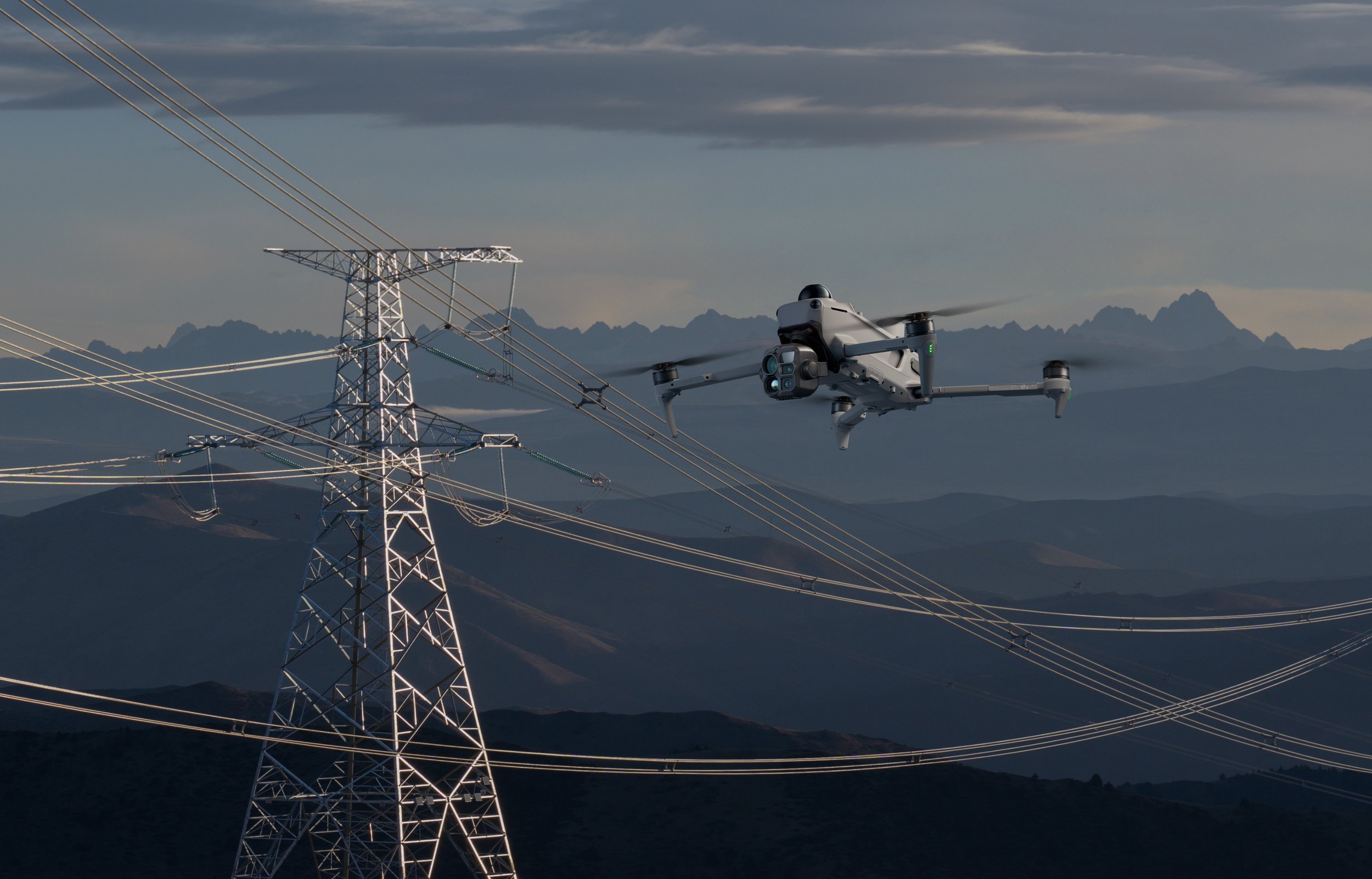
The built-in LiDAR can detect obstacles such as power lines and display their position and distance as an augmented-reality overlay in the flight view. DJI quotes wire detection at up to 32 metres under its test conditions.
The aircraft’s mmWave radar provides forward, upward and downward sensing. DJI states that radar can operate through rain, fog and dust, giving the aircraft an additional sensing method when visibility is reduced.
The Matrice 5T also provides a colour Flight Assist view, allowing the pilot to monitor the aircraft’s surroundings while using the main camera to inspect or track a subject.
Obstacle sensing is an aid to the pilot. Detection performance can vary with the environment, flight speed, sensor direction and the size or material of an obstacle.
Automated Power Line Following
For power line inspections, the Matrice 5T can use its top-mounted LiDAR to detect and track conductors and ground wires. The aircraft can then fly sideways along the line, helping reduce repetitive manual flying while the operator concentrates on inspection imagery.
Laser Ranging and PinPoint
The Matrice 5T’s laser rangefinder has a maximum quoted range of 3 km, compared with 1.8 km on the Matrice 4T. Operators can use the rangefinder and PinPoint features to mark a location and share it with other team members.
In a search and rescue operation, for example, a pilot could use the thermal camera to locate a possible subject, use the zoom camera to investigate, and then mark the location to help direct a ground team.
More Intelligent Detection with Onboard AI
The Matrice 5T supports more than 20 onboard AI detection categories across its visible and thermal imaging workflows. The aircraft can analyse imagery onboard to help operators identify objects and focus their attention on relevant parts of a scene.
Visible-light detection capabilities include people and clothing colours, vehicle and vessel types, animals, smoke and fire. For example, clothing-colour detection may help a search team narrow down people matching a description.
For Australian agricultural and rural users, the inclusion of animal categories such as ox and cattle is also valuable for livestock-related applications.
Thermal detection categories include people, vehicles and vessels. Detection results should always be reviewed and confirmed by the operator.
Custom AI Solutions
The Matrice 5T also supports third-party AI algorithms, opening opportunities for organisations with more specialised detection requirements.
Prisma Technologies develops custom AI solutions for customers that need capabilities tailored to their operations. Our team can work with organisations to explore custom models for onboard use with the Matrice 5T, subject to the supported deployment and hardware requirements.
DJI Pilot 2 Custom Plugins
The Matrice 5T supports custom plugins for DJI Pilot 2, allowing third-party functionality to be integrated into the pilot’s existing flight interface.
This creates opportunities to bring custom tools, information and workflows closer to the operator. For example, organisations may be able to develop interfaces for specialised inspections, map annotations or other mission-specific applications.
Our development team is looking forward to exploring how this capability can support tailored drone workflows for Australian organisations.
Mapping and 2.5D Modelling
The Matrice 5T is designed to do more than capture thermal and inspection imagery. Its wide camera also supports time synchronisation, helping associate images with accurate position and orientation data for mapping and modelling workflows.
Under suitable capture and processing conditions, the Matrice 5T can achieve approximately 10 cm checkpoint accuracy at 120 metres above ground level. Actual results depend on factors such as positioning, flight planning, site conditions and processing, and should be checked against the requirements of each project.
The aircraft also supports local 2.5D modelling, allowing operators to generate a quick map on the controller for annotation and measurement. DJI states that a map can be generated from 200 photos in approximately eight minutes under its test conditions.
Rolling Shutter and Survey Considerations
The Matrice 5T’s wide camera uses an electronic rolling shutter. This means the image is captured line by line, and movement during capture can introduce geometric distortion.
DJI Terra includes rolling-shutter optimisation to help account for these effects during reconstruction. This makes the Matrice 5T a versatile option for organisations that need to collect mapping data alongside thermal and visual inspection imagery.
For dedicated, high-accuracy surveying applications, however, we would still generally recommend considering a purpose-built mapping system such as the DJI Matrice 4E or the DJI Matrice 400 with Zenmuse P1, depending on the project’s accuracy and deliverable requirements.
Up to 59 Minutes of Flight Time
The Matrice 5T offers a maximum quoted flight time of up to 59 minutes, compared with up to 49 minutes for the Matrice 4T. It can also reach a maximum speed of 23 m/s, or approximately 83 km/h, under the stated conditions.
The aircraft uses redesigned propellers intended to improve efficiency and reduce noise. Optional anti-icing propellers are also available for suitable cold-weather operations.
Maximum flight times are measured under specific test conditions. Actual operating time will vary depending on weather, accessories, flight behaviour and the battery reserve required for the mission.
Three-Battery Charging Hub
The Matrice 5 Series Charging Hub holds up to three flight batteries and charges them sequentially. DJI quotes approximately 30 minutes to charge one battery from 10% to 95% under its specified conditions.
The hub includes active cooling and offers Standard and Standby charging modes. With a suitable power supply and battery rotation, operators can reduce downtime between flights.
DJI RC Plus 3 Enterprise Controller
The Matrice 5T is operated using the DJI RC Plus 3 Enterprise controller. Its 7.44-inch screen offers a resolution of 1920 × 1440 in a 4:3 aspect ratio, providing more vertical screen space for flight information, maps and split-screen camera views.
The display reaches 2,000 nits of brightness, approximately 43% more than the 1,400-nit display on the RC Plus 2 Enterprise. The controller also has an IP54 rating and a quoted internal battery runtime of up to six hours.
Improved Transmission and Built-In Dual 4G
The Matrice 5T transmission system adds sub-2 GHz frequency support and a high-gain smart antenna array to help maintain a reliable connection in challenging environments. Available frequencies and performance depend on the region and operating conditions.
The aircraft also has two built-in 4G enhanced-transmission modules, so customers do not need to purchase separate 4G dongles for the aircraft. A dual-carrier setup can provide additional network resilience where supported by the SIM configuration, mobile services and coverage.
The RC Plus 3 Enterprise has its own built-in 4G module. Appropriate SIMs, data plans and network coverage are still required.
Flexible Relay Operations
The Matrice 5T supports single-hop and dual-hop relay configurations, allowing a relay aircraft to help maintain a connection where terrain or other obstacles affect the direct link to the working aircraft.
Relay capability does not replace the need to comply with applicable aviation regulations or obtain any approvals required for a particular operation.
Optional Accessories and Future Parachute Support
The optional DJI AL2 Spotlight offers spotlight, floodlight and strobe modes for night operations and inspections. The optional DJI AS2 Speaker supports live speech, recordings and text-to-speech for communication with people on the ground.
DJI also plans to introduce DJI AP1 parachute compatibility for the Matrice 5T in early 2027. Availability and compatibility are subject to DJI’s final release.
DJI Matrice 5T vs Matrice 4T
| Feature | DJI Matrice 4T | DJI Matrice 5T |
|---|---|---|
| Aircraft weight | Approximately 1.219 kg | Approximately 2.239 kg |
| Aircraft IP rating | No published IP rating | IP55 |
| Native thermal resolution | 640 × 512 | 1280 × 1024 |
| Telephoto focal length | 168 mm equivalent | 252 mm equivalent |
| Maximum hybrid zoom | 112× | 176× |
| Laser rangefinder | Up to 1.8 km | Up to 3 km |
| Obstacle sensing | Omnidirectional vision sensing | Built-in LiDAR, mmWave radar and omnidirectional vision sensing |
| Maximum flight time | Up to 49 minutes | Up to 59 minutes |
| Maximum accessory payload | 200 g | 400 g |
| Flight battery capacity | 99.5 Wh | 215.2 Wh |
Maximum flight time and range figures are based on DJI specifications and test conditions. Actual results will vary.
Who Is the DJI Matrice 5T For?
The Matrice 5T is suited to organisations looking for a portable aircraft that can support several operational roles without changing camera payloads.
- Search and rescue: Locate potential subjects with thermal imaging, investigate with the zoom camera and share marked locations with ground teams.
- Emergency response: Assess incidents, gather situational awareness and communicate with people on the ground using the optional speaker.
- Infrastructure and power line inspection: Capture thermal and visual detail, identify potential issues and use LiDAR-assisted workflows around power lines.
- Public safety and security: Monitor large areas, support response teams and identify people or vehicles using the aircraft’s cameras and AI features.
- Agriculture and rural operations: Monitor property and livestock, inspect infrastructure and use thermal imaging to support field operations.
- Mapping and modelling: Capture site imagery and generate rapid local maps alongside other inspection tasks.
Australian Flight and Travel Considerations
At approximately 2.239 kg, the Matrice 5T sits above CASA’s sub-2 kg excluded category for commercial operations. Most business operations will require an appropriately rated Remote Pilot Licence and operation under a ReOC, unless an applicable exception applies. Requirements depend on the type and location of the operation.
The Matrice 5T’s flight battery is rated at 215.2 Wh. Batteries above 160 Wh are prohibited in passenger carry-on and checked baggage under CASA’s guidance and must be transported separately as dangerous goods. This is an important consideration for organisations that travel between sites by air.
For more information, refer to CASA’s drone weight categories and requirements and CASA’s lithium battery guidance.
Frequently Asked Questions About the DJI Matrice 5T
What is the DJI Matrice 5T used for?
The DJI Matrice 5T is an enterprise drone designed for applications including search and rescue, emergency response, infrastructure inspection, public safety, security, agriculture and mapping. It combines thermal imaging, zoom cameras, a laser rangefinder and advanced obstacle sensing in a portable aircraft.
What is the difference between the DJI Matrice 5T and Matrice 4T?
The Matrice 5T offers several upgrades over the Matrice 4T, including an IP55 aircraft rating, a higher-resolution thermal camera, a longer telephoto lens, built-in LiDAR and mmWave radar, and up to 59 minutes of flight time. The Matrice 4T is smaller and lighter, with a flight battery that is more convenient for airline travel.
What is the thermal camera resolution on the DJI Matrice 5T?
The Matrice 5T has a native thermal resolution of 1280 × 1024. This provides four times the total native thermal pixel count of the Matrice 4T’s 640 × 512 thermal camera. The Matrice 5T also supports enhanced thermal output at up to 2560 × 2048.
Can the DJI Matrice 5T measure temperatures?
Yes. The Matrice 5T’s thermal camera can be used to measure temperatures and identify potential hotspots. It also supports a professional temperature-calibration workflow using blackbody references. DJI advises that calibration should only be performed under professional guidance.
Can the DJI Matrice 5T fly in the rain?
The Matrice 5T has an IP55 aircraft rating, providing protection against dust and water ingress. This makes it better suited to challenging weather than a drone without an IP rating. However, it is not waterproof, and operators should follow DJI’s operating instructions and assess the conditions before flying.
How far can the DJI Matrice 5T zoom?
The Matrice 5T has an 11× telephoto camera with a 252 mm equivalent focal length and supports up to 176× hybrid zoom. Hybrid zoom combines optical reach and digital enlargement, so the level of usable detail will depend on factors such as distance, lighting, focus and aircraft movement.
Does the DJI Matrice 5T have night vision?
Yes. The Matrice 5T supports full-colour Night Scene Mode on its wide, medium telephoto and telephoto cameras. Its telephoto camera also supports monochrome night vision with a near-infrared auxiliary light, which DJI rates for illumination at up to 100 metres.
Can the DJI Matrice 5T detect and follow power lines?
Yes. The Matrice 5T’s built-in LiDAR can detect power lines and display them in the flight view. It also supports an automated power-line inspection feature that tracks conductors and ground wires while the aircraft flies sideways along the line. Detection depends on the operating conditions, and the pilot remains responsible for the flight.
Can the DJI Matrice 5T detect cattle and other animals?
Yes. The Matrice 5T supports onboard AI detection categories that include animals such as ox and cattle. Its visible-light detection capabilities also include people, clothing colours, vehicle types, vessels, smoke and fire. Detection results should be checked by the operator.
Can the DJI Matrice 5T be used for mapping?
Yes. The Matrice 5T can capture imagery for mapping and modelling and supports local 2.5D map generation on the controller. Under suitable conditions, it can achieve approximately 10 cm checkpoint accuracy at 120 metres above ground level. Actual results depend on positioning, capture and processing conditions.
Is the DJI Matrice 5T suitable for surveying?
The Matrice 5T can collect useful mapping data alongside thermal and visual inspection imagery. For dedicated high-accuracy surveying, a purpose-built solution such as the DJI Matrice 4E or Matrice 400 with Zenmuse P1 may be more suitable, depending on the required accuracy and deliverables.
How long can the DJI Matrice 5T fly?
DJI quotes a maximum flight time of up to 59 minutes under its specified test conditions. Actual flight time will vary depending on wind, temperature, accessories, flight behaviour and the battery reserve required for the mission.
How long does it take to charge a DJI Matrice 5T battery?
DJI quotes approximately 30 minutes to charge one battery from 10% to 95% under its specified conditions. The Matrice 5 Series Charging Hub holds up to three batteries and charges them sequentially, one at a time.
Does the DJI Matrice 5T have built-in 4G?
Yes. The Matrice 5T aircraft has two built-in 4G enhanced-transmission modules, so separate aircraft 4G dongles are not required. A dual-carrier setup may provide additional network resilience where supported. Suitable SIMs, data plans and network coverage are required.
Does the DJI Matrice 5T support a parachute?
DJI plans to introduce compatibility between the Matrice 5T and the DJI AP1 parachute in early 2027. Final availability and compatibility are subject to DJI’s release.
Do I need a licence to fly the DJI Matrice 5T in Australia?
The Matrice 5T weighs approximately 2.239 kg and sits above CASA’s sub-2 kg excluded category. For most business operations, pilots will need an appropriately rated Remote Pilot Licence and must operate under a ReOC. Exceptions may apply to qualifying landholder operations. Drones used for business must also be registered with CASA.
Requirements depend on the operation. Refer to CASA’s drone weight categories and requirements for further information.
Can I take DJI Matrice 5T batteries on a passenger aircraft?
No. The Matrice 5T flight battery is rated at 215.2 Wh, above CASA’s 160 Wh limit for passenger baggage. The batteries cannot be carried in passenger carry-on or checked baggage and must be transported separately as dangerous goods. See CASA’s lithium battery guidance.
How much does the DJI Matrice 5T cost in Australia?
Pricing depends on the aircraft package, accessories and support required. Contact Prisma Technologies for a tailored quote and advice on the right Matrice 5T configuration for your operation.
Find Out More About the DJI Matrice 5T
The DJI Matrice 5T is a substantial step up in capability from the Matrice 4T, particularly for organisations that value weather protection, improved thermal detail, longer zoom, advanced sensing and extended flight time.
As a DJI Enterprise Tier S Dealer, Prisma Technologies can assist with product advice, equipment selection, training, custom integrations and ongoing support.
Contact Us About the Matrice 5T →